
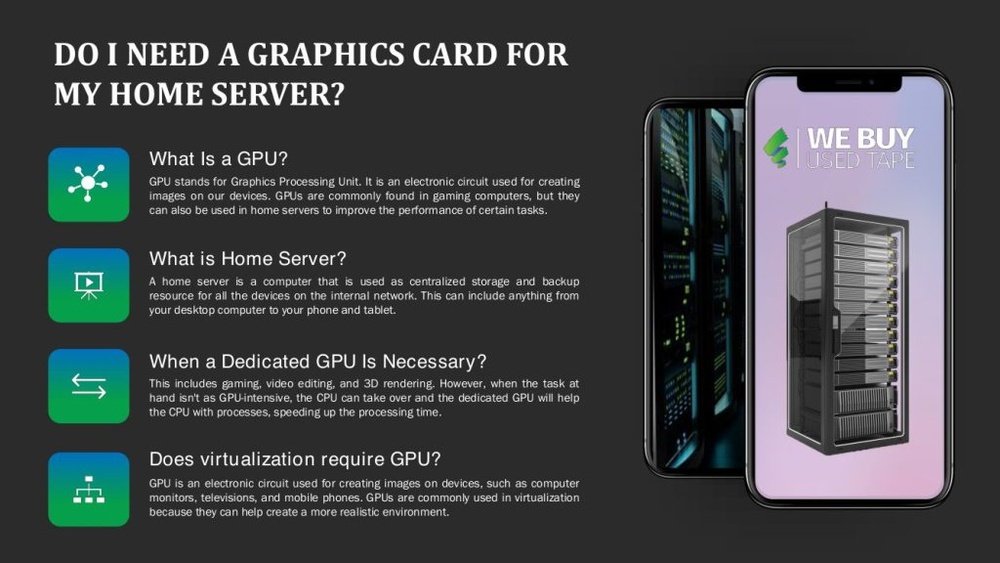
Are you wondering if your server really needs a GPU? It’s a question many people ask, especially when building or upgrading a server.
You might think a GPU is only for gaming or graphic design, but the truth is more complex. Understanding whether a GPU can boost your server’s performance or just add unnecessary cost is key. Keep reading to discover how a GPU could change the way your server works—and whether it’s the right choice for your needs.
Role Of Gpus In Servers
GPUs play an important role in many servers today. They help process many tasks at the same time. This ability makes them useful for certain jobs.
Servers often handle large amounts of data. GPUs speed up data processing by working on many parts at once. This is different from traditional CPUs.
Tasks like machine learning, video rendering, and scientific simulations benefit from GPUs. These tasks need high computing power and fast processing.
Gpu Vs Cpu: Key Differences
CPUs are good at handling a few tasks quickly. They focus on one or a few instructions at a time. CPUs are very flexible for many types of work.
GPUs have many smaller cores. They work on many tasks at once. This makes GPUs better for parallel processing tasks. GPUs excel in handling graphics and complex calculations.
For servers, this means GPUs can speed up specific jobs. CPUs handle general tasks and control the system.
Types Of Gpus For Servers
There are different GPU types designed for servers. Some are made for high-performance computing. Others focus on energy efficiency or cost savings.
Professional GPUs support tasks like AI training and data analysis. They have more memory and better reliability than consumer GPUs.
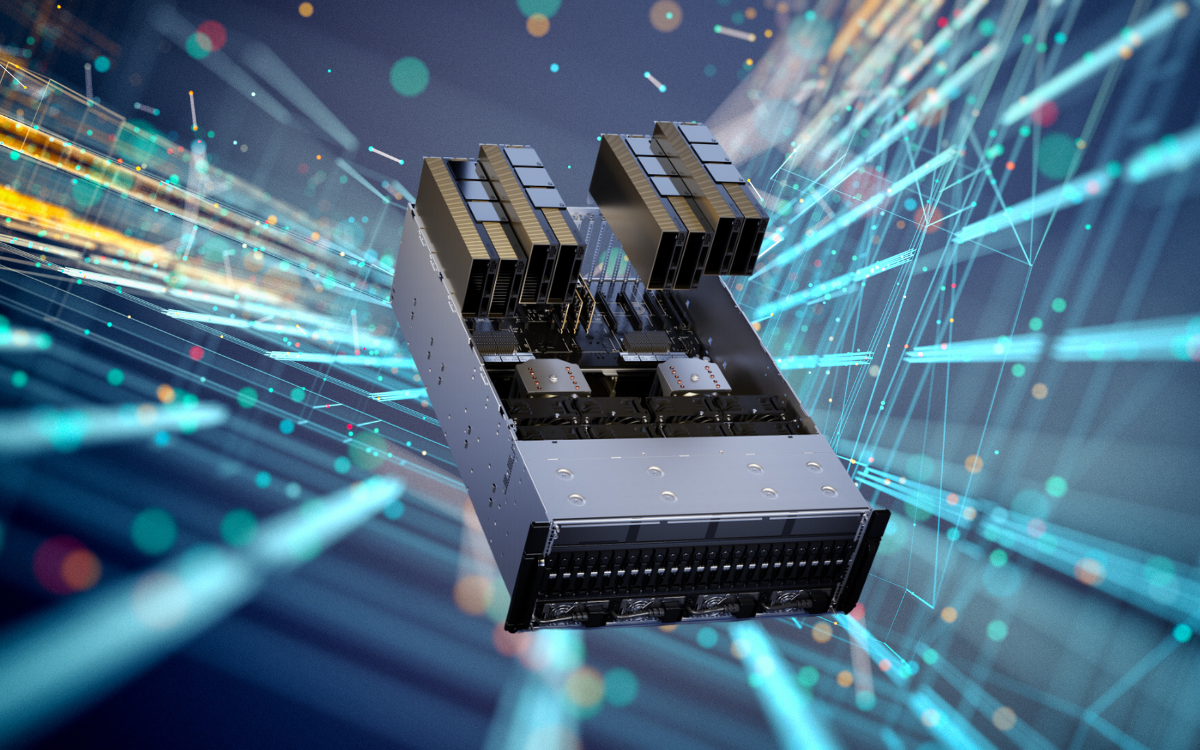
Some GPUs are built to fit into server racks. These are compact and designed to work in data centers. Choosing the right GPU depends on the server’s workload.
Performance Boosts From Gpus
GPUs provide a clear performance boost for many server tasks. They handle complex calculations much faster than CPUs alone. This speed helps servers manage heavy workloads with ease. Servers equipped with GPUs can process large data sets quickly. This ability improves overall efficiency and reduces wait times.
GPU power supports specific server functions better than traditional processors. Tasks that require parallel processing benefit the most. These tasks include data analysis, machine learning, and virtualization. The presence of a GPU in a server can greatly enhance these operations.
Accelerating Data Processing
GPUs excel at handling many operations simultaneously. This skill makes data processing faster and smoother. Large databases and real-time analytics benefit from GPU acceleration. Servers can analyze more data in less time. This speed helps businesses make quicker decisions.
Enhancing Machine Learning Tasks
Machine learning depends on heavy calculations and data crunching. GPUs speed up training of models by managing many tasks at once. Servers with GPUs complete learning tasks faster than those without. This boost helps improve AI applications and predictions. Developers can test and deploy models more quickly.
Improving Virtualization
Virtual machines run better with GPU support. GPUs help distribute graphics and computing power across virtual environments. This support leads to smoother user experiences and faster response times. Servers with GPUs handle more virtual machines efficiently. This improvement benefits cloud services and remote desktops.
Use Cases For Gpu-enabled Servers
GPU-enabled servers are designed to handle tasks that require high-speed data processing. They are ideal for jobs that need heavy computing power. These servers boost performance and reduce the time needed for complex tasks. Their use is growing in many fields that demand fast and efficient data handling.
Ai And Deep Learning Applications
GPUs speed up AI and deep learning tasks. They process many calculations at once, making training faster. Large datasets are handled smoothly with GPUs. This helps create smarter AI models in less time. Tasks like image recognition and language processing benefit greatly.
Graphics Rendering And Visualization
Servers with GPUs produce high-quality graphics quickly. They are used for rendering videos, animations, and 3D models. Visual effects in movies and games are created faster. Architects and designers use these servers to see detailed models clearly. The speed and quality improve creative work.
Scientific Simulations
Scientific research often needs powerful computing. GPU servers simulate complex systems like weather or molecules. These simulations run faster than on normal servers. Researchers get results quickly and can test more ideas. This helps in fields like physics, biology, and chemistry.

Credit: cloudminister.com
Cost And Energy Considerations
Cost and energy matter a lot when deciding if a server needs a GPU. Servers with GPUs can do heavy tasks faster. But they also cost more and use more power. These factors can affect a business’s budget and energy bills. Understanding these costs helps make a smart choice.
Initial Investment And Roi
GPUs add to the initial cost of a server. High-quality GPUs are expensive parts. Buying and installing them raises the total price. Businesses must think about how fast they will earn back this money. Faster task completion can improve productivity and profits. This speed might cover the cost over time. Not every job needs a GPU, so the return on investment (ROI) varies by use.
Power Consumption Impact
GPUs use more electricity than CPUs alone. This increase raises the server’s power needs. Higher power means bigger electricity bills. It also creates more heat, requiring better cooling systems. Cooling adds to energy costs too. Energy use affects the environment and operating expenses. Choosing the right GPU size helps balance power and performance. Efficient GPUs save money and reduce carbon footprints.
When Gpus Might Not Be Necessary
Not every server needs a GPU. Many servers run well without one. Deciding if a GPU is necessary depends on what tasks the server performs.
Servers often handle simple tasks that do not require heavy graphics or processing power. In these cases, adding a GPU might not bring extra benefits. It can increase costs and complexity without improving performance.
Basic Server Tasks
Servers that handle emails, file storage, or web hosting usually do not need GPUs. These tasks rely more on the CPU and memory. A GPU offers little to no advantage for them. The server can work efficiently without the extra hardware.
Simple database operations and small-scale applications also run fine without GPUs. The focus is on reliability and speed of the CPU. Adding a GPU does not enhance these functions.
Cost-sensitive Environments
Some businesses must manage budgets carefully. GPUs add cost to the server build and operation. Power consumption and cooling needs increase with GPUs. These extra costs can be a burden.
For companies with tight budgets, skipping the GPU saves money. They can invest in better CPUs or more memory instead. This approach keeps servers affordable and efficient.
Credit: cloudpap.com
Future Trends In Server Gpu Usage
Server GPUs are becoming more common in data centers. They help with fast computing and complex tasks. The use of GPUs in servers will grow in the near future. New technology and changing needs push this growth. Understanding these trends helps businesses plan better.
Servers with GPUs can handle large workloads quickly. This makes them useful for many industries. The next few years will bring many changes in GPU use for servers.
Advances In Gpu Technology
GPU makers are improving power and efficiency. New models use less energy but work faster. GPUs now support more types of tasks. They can run artificial intelligence and data analytics better. Smaller, more powerful GPUs fit into server racks easily. These advances make GPUs more useful for servers.
Emerging Workloads Driving Demand
New workloads need strong computing power. AI training and machine learning need GPUs to work well. Data analysis on big data sets also needs GPUs. Cloud services use GPUs to provide better speed. Video processing and virtual reality require GPU power. These new tasks push companies to add GPUs to servers.

Credit: truehost.com
Frequently Asked Questions
Does Every Server Require A Gpu?
Not every server needs a GPU. Servers handling standard tasks rely on CPUs. GPUs are essential for graphics-intensive or parallel processing workloads.
When Should A Server Use A Gpu?
A server should use a GPU for AI, machine learning, and video processing. GPUs accelerate data-heavy and complex computations, improving performance significantly.
Can A Server Work Without A Gpu?
Yes, many servers operate without GPUs. They handle web hosting, file storage, and database management efficiently using only CPUs.
How Does A Gpu Improve Server Performance?
GPUs enhance server performance by accelerating parallel processing. They handle multiple tasks simultaneously, reducing processing time for complex computations.
Conclusion
Choosing a GPU for a server depends on the tasks it handles. Some servers need strong graphics power, while others do not. Servers used for gaming, AI, or video work benefit from a GPU. Basic servers work fine without one.
Think about what your server must do before deciding. A clear plan saves money and improves performance. The right hardware helps servers run smoothly and fast. Keep your needs simple and your setup efficient.
